
Getting started with EDGY.
Your quick start to the EDGY language: Facet Model & Visual Notation.
This EDGY Fast Track is designed to get you up to speed quickly. You will learn how to navigate enterprise complexity and use a shared language that connects every stakeholder, from strategy to execution.
EDGY is a holistic, human-centric approach that provides an analysis model and a collaborative visual notation for creating better enterprises.

EDGY is not a heavy framework, but a shared map and a colorful visual language to co-design the enterprise together – accessible for everyone.
The Core of EDGY: Three Facets
- Identity (Why): Why do we exist and what are our promises?
- This is your North Star: the purpose, strategy, principles and values that define who you are.
- Experience (What / To Whom): What do people want to achieve, and what can we offer to help them get their jobs done? How do people perceive and interact with us throughout their journey?
- This is the human side: understanding needs and designing the products and services that fulfill them.
- Architecture (How): How does everything work together to realise our services?
- This covers the operational structures, capabilities, and systems needed to realise our products and services.
Our Identity defines the promises that our Architecture delivers, resulting in the Experience people perceive.
The Intersections: Connecting the Dots
That’s where the magic happens. The facets are not silos. The intersections show us how they connect: Is our identity reflected in our operations? Does our architecture deliver on our identity’s promises and support the customer experience? Does the perceived experience match the promise we made?
- Brand (Identity + Experience): What is our reputation and image when people are interacting with us and our offerings? Do we actually feel like who we say we are?
- Aligning our core promises with how people perceive and experience us.
- Product (Experience + Architecture): Can we actually deliver what people need?
- Connecting our customer offerings to the capabilities and systems that power them.
- Organisation (Architecture + Identity): How do we organise ourselves? Are we built to fulfill our purpose?
- Ensuring our structures and ways of working reflect our strategy and values.

Download the EDGY Fast Track slide deck as a PDF: link
Enterprise Design is Systems Thinking
The true power of EDGY lies in shifting perspectives. It’s about moving between the facets to see the big picture and understanding that in an enterprise, everything affects everything.

The Two Pillars of EDGY
EDGY is built on two core components that work together to bridge the gap between abstract strategy and concrete design:
- The EDGY Facet Model (the Analysis Model) The Facet Model acts as a map for navigating enterprise complexity. It provides three distinct perspectives – Identity, Experience, Architecture, and their intersections (Brand, Organisation, Product) – to help you analyse how different parts of the enterprise relate to one another. It ensures you ask the right questions to uncover hidden insights.
- The EDGY Notation (Our Visual Language) The visual notation is a set of simple, standardised visual elements used to describe and design the enterprise. It provides a shared vocabulary for cross-functional teams, making complex structures easy to see, understand, and communicate.

How they work together:
- The Facet Model helps you understand the problem by shifting perspectives and asking the right questions.
- The Language helps you communicate and design the solution by visualising it clearly – with a shared “alphabet” that anyone can learn in minutes.
The EDGY Facet Model ia a tool for analysis. It provides three distinct lenses that allow you to shift perspectives and see the “big picture” without losing the details.
The EDGY visual notation is a tool for collaboration. It is a set of simple visual elements used to describe and design the enterprise. It provides visual clarity and a shared vocabulary: it replaces complex jargon with simple icons and clear relationships. It works for everyone, whether you are a CEO, a designer, an architect, or a software engineer.
The Synergy
The Facet Model helps you think and analyse, while the language helps you collaborate and design. Together, they ensure that what you analyse is what you actually build.
The EDGY Facet Model
The EDGY Facet Model facilitates analysis across design, development, and innovation initiatives.

The EDGY Facet Model helps you ask the right questions to find the essential elements and their connections within an enterprise.
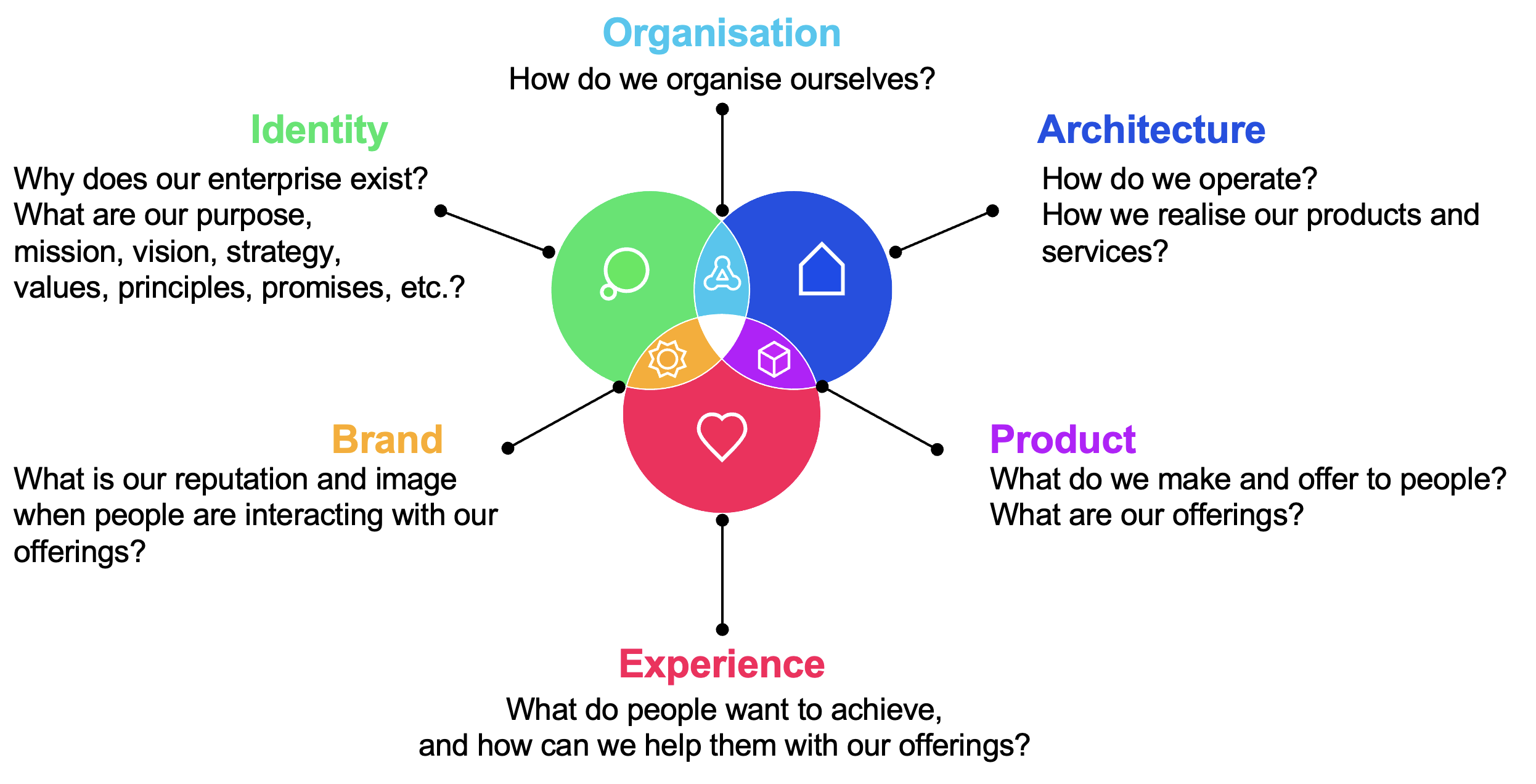
The point of EDGY is in shifting perspectives and seeing the big picture. These detailed questions can be applied to every change demand, request, or development initiative across the enterprise. This ensures that no matter the scale, we always understand the impact on our Identity, Experience, and Architecture – as well as their intersections: Brand, Organisation and Product.

The Enterprise Wheel – the Navigator
The Enterprise Wheel (or Enterprise Design Wheel) tool can be used as a source of inspiration and guidance when starting with an enterprise design & development challenge. Enterprise perspectives and intersections are introduced as sectors of a wheel in two levels: 1) Facets represent the sectors at high-level and 2) enterprise elements represent the sectors at detail-level.
A dynamic navigation tool that allows us to enter the design & development process from any perspective. By “rotating” the wheel, we can zoom in on specific elements.
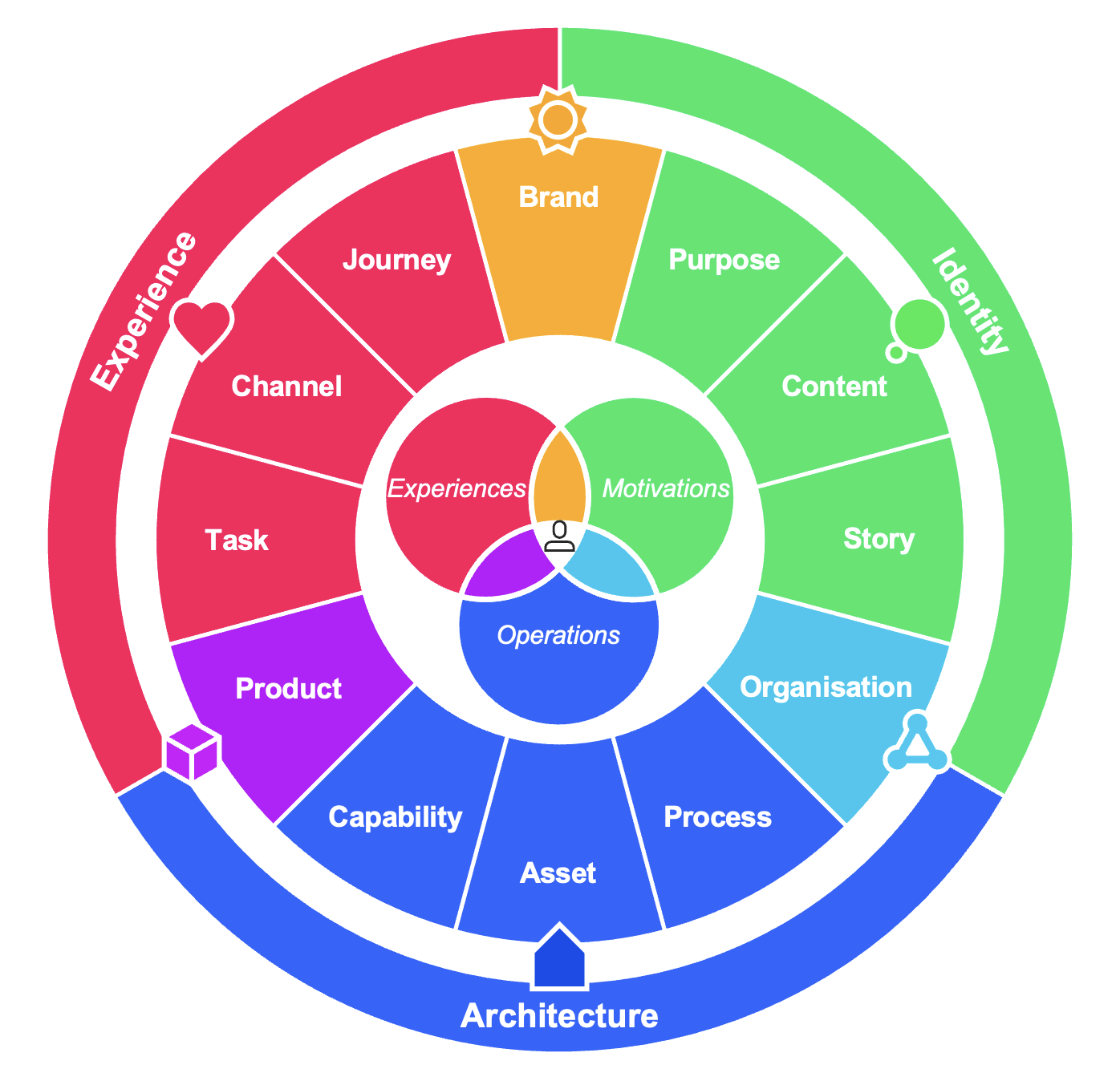
The Enterprise Wheel supports holistic systems thinking and ensures all elements are considered in collaborative co-design and development – everyone is invited.
- A Shared Tool for All Roles
- Provides a single tool for collaborative enterprise design and development for everyone involved, that eliminates “lost in translation” moments by replacing jargon with a universal vocabulary.
- Perspective Switching & Reframing
- Enables perspective switching by rotating through Identity, Experience, and Architecture – allowing stakeholders to see the big picture from different viewpoints and step into each other’s shoes.
- 360-Degree Impact Analysis
- Enables stakeholders to take a holistic view of the enterprise by looking beyond their own area to see how every detail impacts the enterprise as a whole, preventing ‘tunnel vision’.
Analysis can be started on any sector, and then continued to adjacent sectors to any direction. The view can be taken from different viewpoints such as from enterprise, organisation, employee or customer viewpoint.
How to use the Enterprise Wheel?

- Any Point of Entry: You can start your analysis from any perspective depending on your current challenge: Identity (Why?), Experience (What? Who?), or Architecture (How?).
- Dive into the Elements: Once a perspective is chosen, you “zoom in” to the specific EDGY elements to address details.
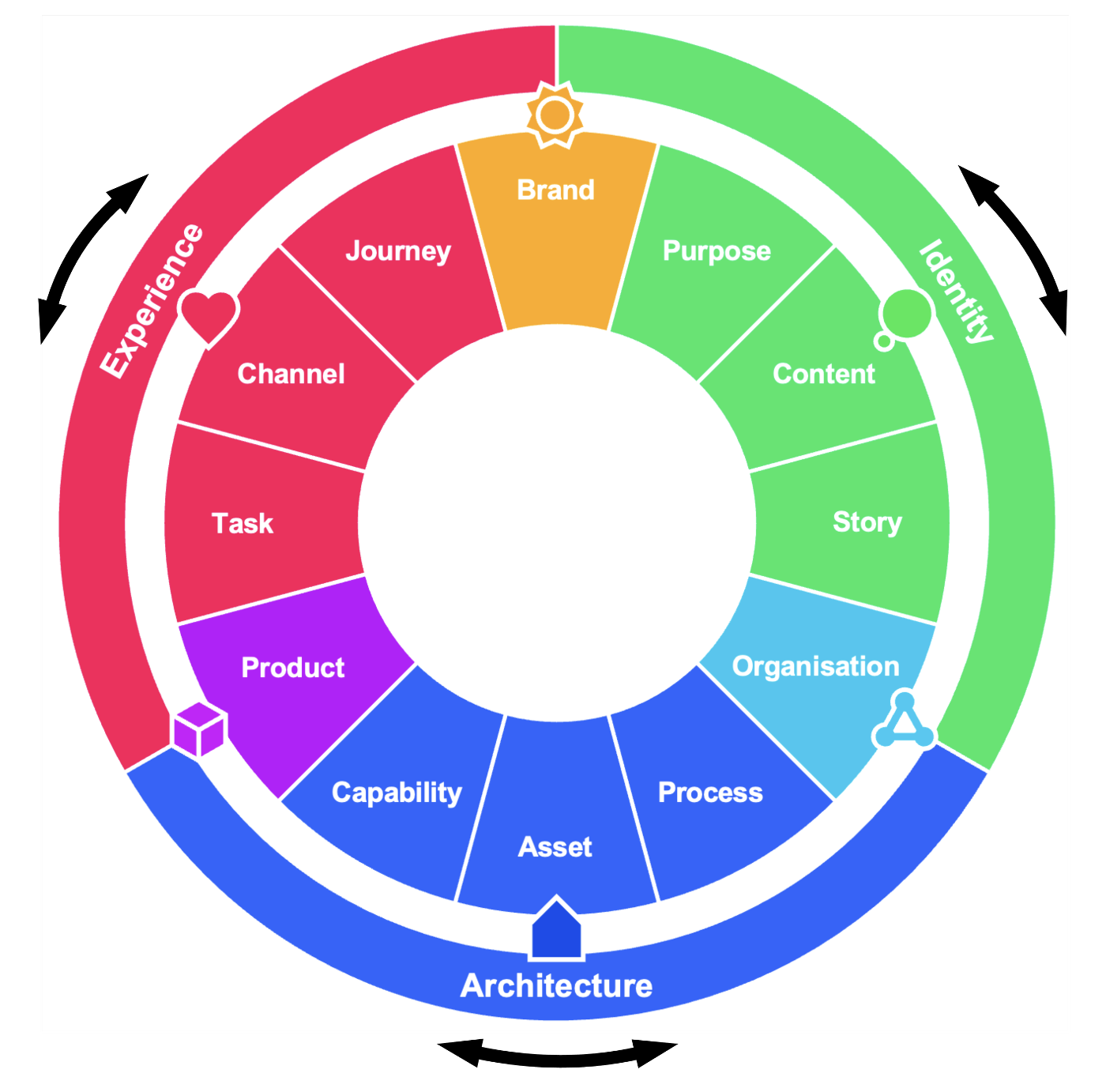
- Turn the Wheel (Clockwise & Anti-clockwise): Rotating the wheel allows you to see the non-obvious connections, to make the invisible visible.
Turn the Wheel
Rotating the Wheel (clockwise and anti-clockwise) allows you to discover non-obvious connections – making the invisible visible.
Why It Makes Things Easier?
- It breaks down silos.
- Invites stakeholders to “step out” of their specialised, comfort zones – to see the forest from the trees.
- It clarifies the interdependencies between elements, showing how everything affects everything else.
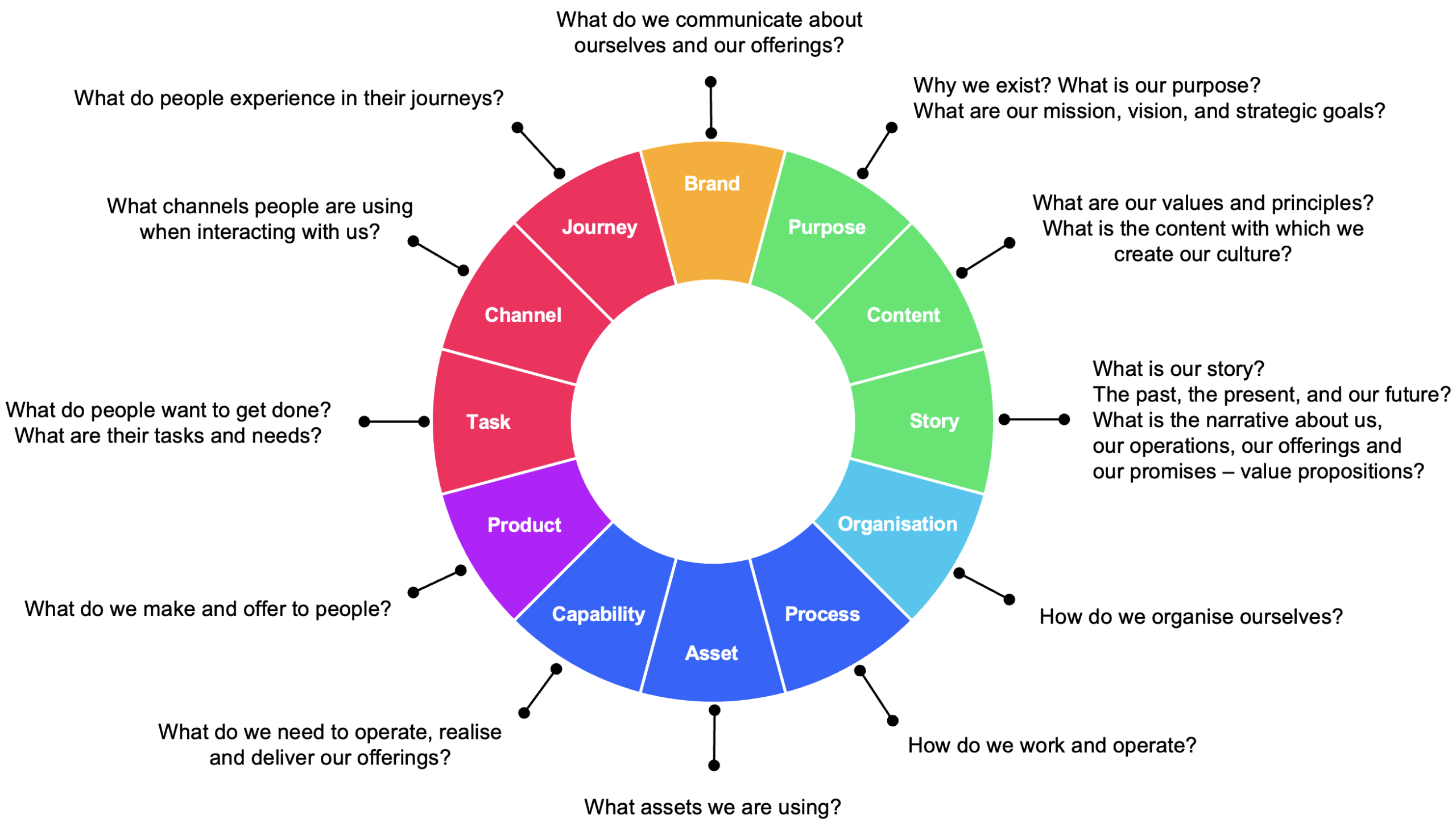
Get a free PowerPoint template from here: link
The Enterprise Wheel supports systems thinking by mapping the relationships between all elements, allowing us to see the enterprise as a dynamic whole and understand how every change impacts the entire system.
The EDGY Visual Notation
Enterprise Design Graph interplaY
Four elements only!

EDGY is based on the FBS (Function – Behavior – Structure) -ontology.

The EDGY Four Base elements are:

These Base elements can be used for depicting all the design challenges.


Base elements are generic elements that can be specialised as shown below.

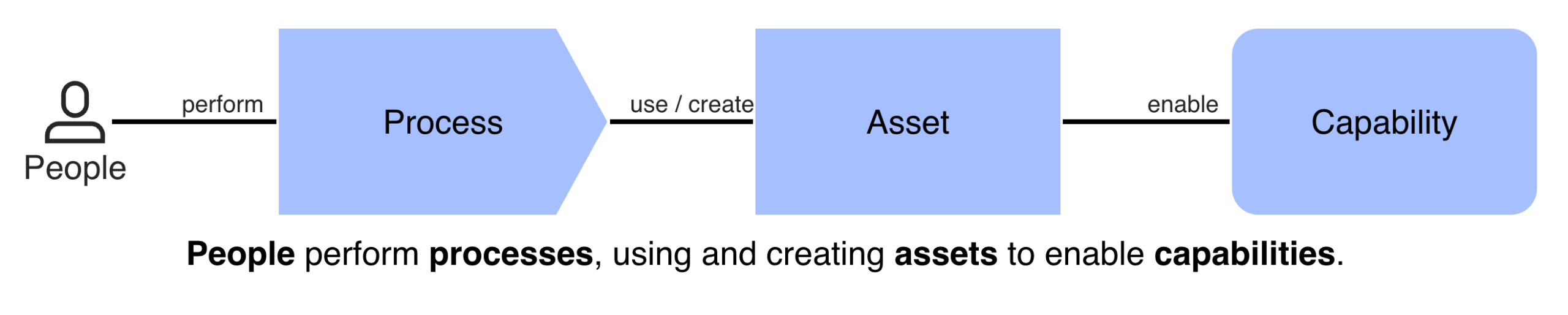
All the base elements have specialised, faceted and colored counterparts in the Facet Model. A similar basic syntax and structure (activity-object-outcome) occurs in every facet. This makes it easy to translate and shift the focus from one facet to another, as the elements are related to each other.
EDGY’s conceptual foundation
The four base elements form EDGY’s conceptual foundation, from which the elements of the three facets – Identity, Experience, and Architecture – are derived.
Base level – generic elements:
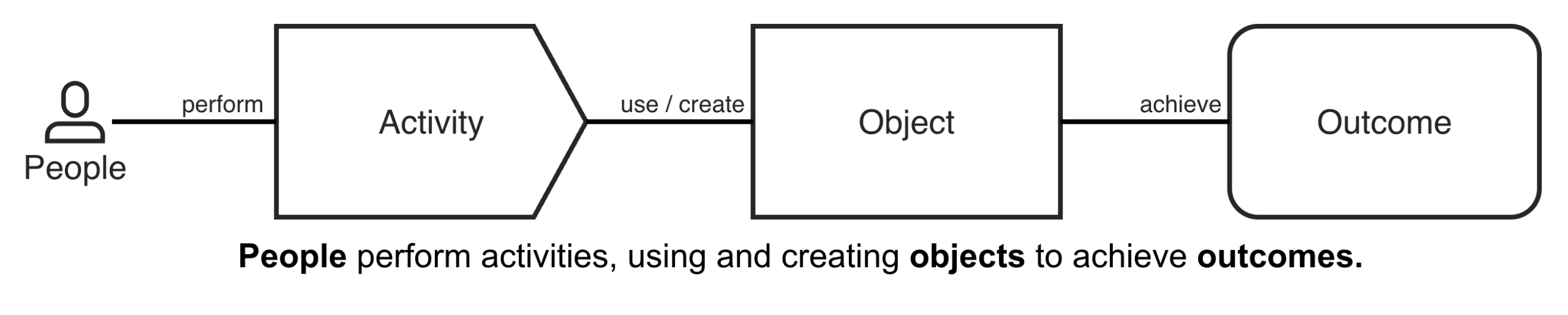
The Architecture of enterprise operations:
People’s Experience:

The Identity of an enterprise:

The simplicity of the EDGY language’s syntax, and its vocabulary of limited concepts and a small number of connection types, makes the EDGY easy to learn and use, but expressive enough.
- Outcomes are round-edged.
- Objects, representing structural elements, are square-edged.
- Activities are arrow-shaped.

Default relations between the elements:

Visualisation
EDGY:
- High-level modeling language
- Complements other languages
- A common language for everyone

EDGY:
- Suitable for everyone
- A common language for cross-functional teams
- Visually clear and simple
- Easy to learn, easy to understand
- Productive
- Allows focusing on the design problem, not the notation

The EDGY Way
The EDGY Way is a holistic, human‑centric, and collaborative approach to enterprise design, aimed at developing better enterprises.
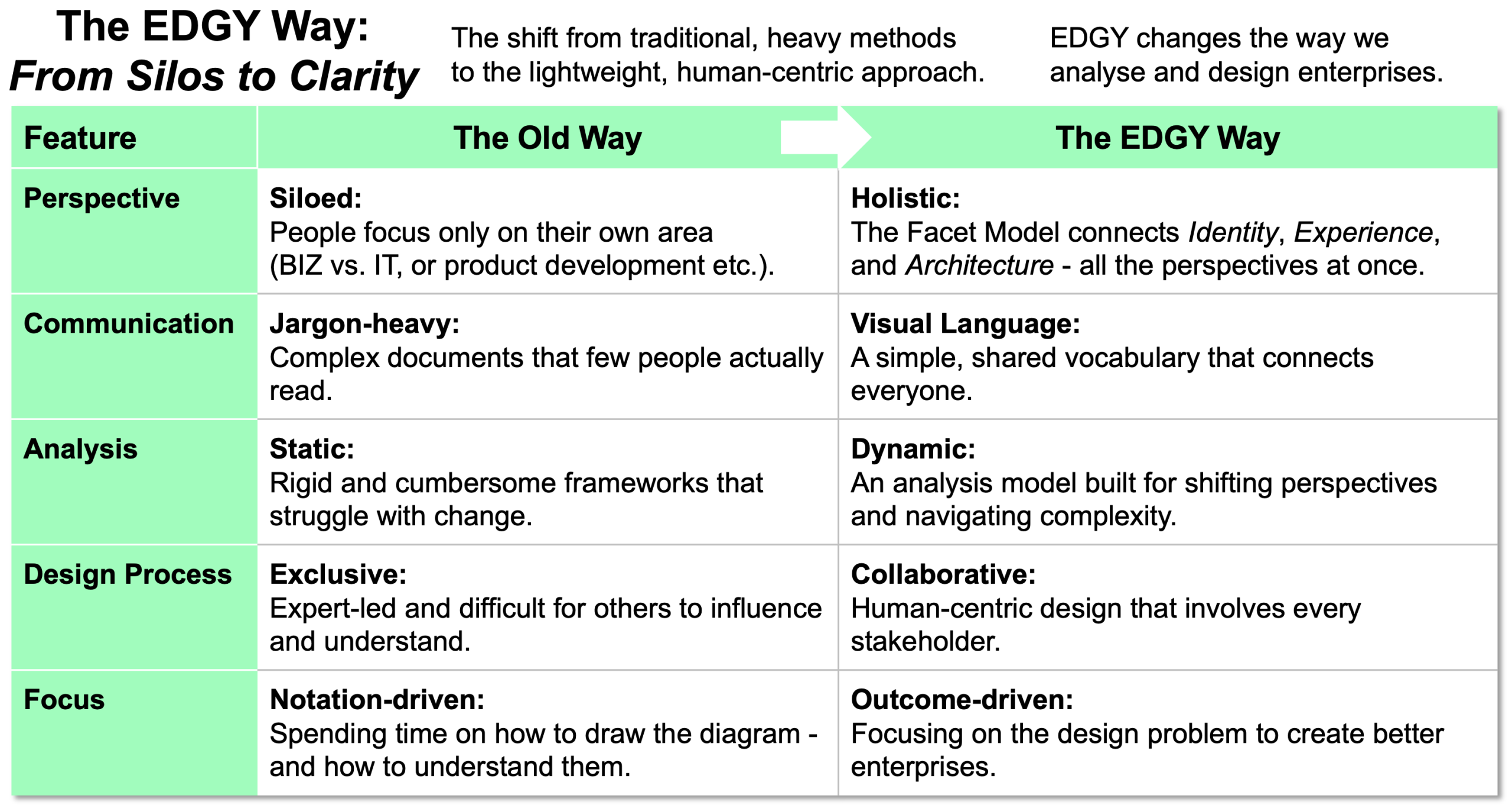
The EDGY Way – from silos to clarity.
EDGY provides a shared foundation for navigating complexity and collaborating across people, functions, and disciplines to create better enterprises – not by applying heavyweight frameworks, but through a common, visual language and perspective‑based analysis.
Core Principles:
1. Holistic view with three facets
The EDGY Way frames an enterprise through three core facets:
- Identity (Why) – our purpose, promises, values and strategic intent
- Experience (What/For whom) – what people want to achieve and how they interact with our enterprise
- Architecture (How) – how people, processes and assets work together within our capabilities to deliver on experience and identity
These facets aren’t silos – their intersections (Brand, Product, Organisation) show how purpose, experience, and execution connect meaningfully.
2. Shared language for collaboration
EDGY is a simple, visual, collaborative visual notation that everyone can learn quickly, from strategy to execution. Its common vocabulary enables cross‑functional disciplines and teams to communicate clearly about complex enterprise behaviours and structures.
3. Navigate enterprise complexity
Instead of tools that emphasise process or technology alone, the EDGY Way helps people navigate complexity by asking the right questions across different enterprise perspectives – identity, experience, architecture – to uncover insights and make better design decisions – for creating better enterprise.
In Short: The EDGY Way is not primarily a methodology or a rigid framework. It’s:
- A human‑centric design orientation
- A shared analysis model (EDGY Facet Model)
- A collaborative visual language (EDGY notation)
Holistic → captures the three facets (Identity, Experience, Architecture)
Human‑centric → focuses on people, stories, journeys, processes
Collaborative → emphasises shared language and cross-functional alignment
The “EDGY Way” refers to a holistic, human‑centric and collaborative approach to understanding, describing, and shaping enterprises using the EDGY language: the Facet Model and visual notation.
Getting Started
Your Kickstart: first steps:

- Identify your “Anchor”: Pick a challenge. Is it a brand identity issue, a broken customer experience, or a technical architecture bottleneck?
- Shift Perspectives: Use the Facet Model to look at your challenge through the other lenses. For example, if you started with Architecture (e.g. with specific process or application), ask: “How does this impact the Experience?” “Is this aligned with our Identity, our purpose, our goals?”
- Speak the Language: Stop using complex jargon and difficult frameworks and notations. Start talking customer- and business value, and start sketching your challenge using the simple EDGY elements (like People, Activities, Objects, and Outcomes).
- Connect Everyone: Don’t design in a silo. Invite others from different departments and disciplines to review your map. Use the shared visual language to find common ground.

Material:
Intersection Group pages for more information:
- Enterprise Design with EDGY (open-source tool)
- Intersection Group (not-for-profit organisation)
Download the EDGY Fast Track slide deck as a PDF: link
— Eero Hosiaisluoma